sales@scjumbrellas.com
86-17814603169

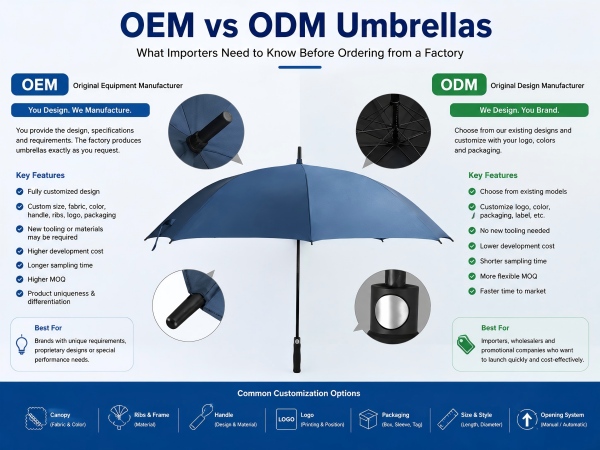
If you are planning to source umbrellas from a manufacturer, you will probably come across two terms very quickly: OEM umbrellas and ODM umbrellas.
Both models allow importers, wholesalers, retailers, promotional product companies, and private-label brands to source umbrellas directly from a factory. However, the amount of customization, development time, cost, and minimum order quantity can be very different.
Should you choose an existing umbrella design and simply add your logo? Should you customize the fabric, handle, ribs, colors, and packaging? Or should a factory manufacture an entirely new umbrella according to your own design?
Understanding the difference between OEM and ODM umbrella manufacturing can help you choose the right sourcing strategy, control costs, shorten lead times, and avoid unnecessary product-development risks.
This guide explains the differences between OEM and ODM umbrellas and what B2B buyers should consider before placing a bulk umbrella order.
OEM stands for Original Equipment Manufacturer.
In an OEM project, the buyer typically has specific product requirements, designs, technical specifications, or branding requirements, and the umbrella manufacturer produces the product according to those requirements.
The level of customization can vary considerably.
For example, an importer may already have an umbrella design and ask a factory to manufacture it with specified:
Umbrella diameter
Folded length
Number of ribs
Rib and shaft materials
Fabric type
Fabric color
Handle design
Opening mechanism
UV protection requirements
Logo printing
Packaging
Labels and hangtags
For more advanced OEM projects, the buyer may provide drawings, samples, Pantone colors, packaging artwork, or other detailed specifications.
The manufacturer then evaluates whether existing components can meet those requirements or whether new tooling, molds, materials, or components are necessary.
Suppose a European outdoor brand wants a custom three-fold automatic umbrella.
The buyer specifies:
105 cm open diameter
10-rib construction
Fiberglass ribs
Black metal shaft
High-density pongee canopy
Black UV coating
Automatic opening
Custom-designed handle
Custom Pantone canopy color
Brand logo on two panels
Printed retail box
The umbrella factory manufactures the product according to these specifications.
This is a typical OEM umbrella manufacturing project.
ODM stands for Original Design Manufacturer.
With ODM sourcing, the umbrella supplier already has existing product designs that buyers can select and customize.
Instead of developing an umbrella from the beginning, the importer chooses an existing model and makes relatively simple changes.
Typical ODM customization may include:
Canopy color
Logo printing
Printing pattern
Handle color
Umbrella pouch
Hangtag
Label
Gift box
Retail packaging
For example, an umbrella manufacturer may already produce a compact five-fold umbrella. A promotional products distributor selects that model, changes the canopy to a corporate color, prints the customer's logo, and uses customized packaging.
The fundamental umbrella structure remains unchanged.
This makes ODM particularly attractive to companies that want to launch private-label umbrellas quickly without investing heavily in product development.
The biggest difference is who controls the original product design and how much development is required.
| Factor | OEM Umbrellas | ODM Umbrellas |
|---|---|---|
| Product design | Based largely on buyer requirements | Existing factory design |
| Customization | High | Low to medium |
| Development time | Usually longer | Usually shorter |
| Tooling requirements | May require new tooling | Usually existing tooling |
| Development cost | Potentially higher | Usually lower |
| Sampling | Often multiple rounds | Usually simpler |
| MOQ | May be higher | Often more flexible |
| Product uniqueness | Higher potential | Lower |
| Time to market | Longer | Faster |
| Best for | Brands with specific requirements | Importers wanting proven products quickly |
Neither model is automatically better.
The right choice depends on your business model and the product you are trying to create.
ODM is often the better solution when speed, cost, and simplicity are priorities.
For example, you may be:
A promotional gift distributor
A wholesaler
An Amazon or e-commerce seller
A supermarket buyer
A corporate gift company
An event merchandise supplier
A company purchasing branded umbrellas for employees or customers
If you simply need a reliable umbrella with your own logo, developing an entirely new structure may not provide much additional value.
Instead, you can select an existing model that has already been manufactured and tested.
You might choose an existing automatic folding umbrella and customize:
Black canopy + white company logo + branded pouch + custom gift box
This approach can significantly simplify the sourcing process.
ODM sourcing can offer several benefits:
Faster product development
Because the basic umbrella already exists, sampling and production preparation can be much faster.
Lower development costs
Existing molds and components reduce the need for tooling investment.
Lower technical risk
A mature umbrella model may already have an established production process.
Easier product selection
Buyers can often evaluate existing samples before committing to a large order.
Ideal for promotional projects
If the main purpose is corporate branding, logo customization may be more important than developing a completely new umbrella structure.
OEM makes more sense when your umbrella needs to be different from standard products already available in the market.
This is particularly important for established brands and importers that want to create a recognizable product line.
You may need OEM manufacturing if you require:
A unique handle
Special umbrella dimensions
A proprietary frame structure
Specific rib materials
Special fabric performance
Unique opening and closing mechanisms
Custom accessories
Special packaging systems
Strict product performance requirements
OEM can also be useful when you already sell an umbrella and need a new factory to manufacture according to your existing specifications.
The biggest benefit is product differentiation.
Instead of selling the same umbrella available to many other importers, you can create a product that better matches your brand positioning.
OEM also provides greater control over:
Product appearance
Materials
Construction
Performance
Packaging
Branding
Target price
However, greater control also means more decisions need to be made before mass production.
Many first-time buyers think custom umbrellas simply mean printing a logo on the canopy.
In reality, an experienced custom umbrella manufacturer may offer customization across almost every major component.
Common fabric options include:
Pongee
Polyester
Nylon
Specialty coated fabrics
Depending on the umbrella type and application, buyers may also request UV-blocking or black-coated canopy materials.
Possible materials include:
Steel
Fiberglass
Aluminum
Mixed-material constructions
The number and structure of ribs can affect umbrella weight, strength, appearance, and cost.
The shaft may vary according to the umbrella design and can use materials such as steel, aluminum, or fiberglass.
Handles can be manufactured from materials such as:
Plastic
Rubberized materials
EVA
Wood
Metal
For larger OEM programs, a custom handle mold may also be possible.
Common options include:
Manual open
Automatic open
Automatic open and close
The mechanism has a significant influence on convenience, product structure, weight, and price.
Depending on the design, logos can be applied to:
Canopy panels
Umbrella straps
Handles
Pouches
Labels
Packaging
Printing methods should be selected according to the fabric, artwork, order quantity, and required appearance.
B2B buyers can also customize:
Polybags
Umbrella sleeves
Gift boxes
Retail boxes
Hangtags
Barcode labels
Shipping cartons
For retail and private-label projects, packaging should be considered at the beginning rather than after the umbrella itself has been finalized.
One of the easiest ways to get an inaccurate quotation is to send a supplier a message saying:
"Please quote 5,000 custom umbrellas."
There simply isn't enough information.
For a more accurate quotation, provide as many details as possible.
A useful umbrella RFQ should include:
Umbrella type
Open diameter
Folded length
Number of ribs
Frame material
Canopy fabric
Fabric coating
Manual or automatic operation
Handle material/design
Required colors
Logo size and printing position
Packaging requirements
Order quantity
Destination country
Required certifications or testing
Target delivery date
If you already have a reference umbrella, photographs and a physical sample can also make communication much easier.
MOQ (Minimum Order Quantity) is one of the most common questions buyers ask an umbrella manufacturer.
There is no universal MOQ for custom umbrellas.
MOQ can depend on:
Umbrella model
Fabric requirements
Custom colors
Printing method
Number of logo colors
Handle customization
Component availability
Packaging
Tooling requirements
An existing ODM umbrella with a simple one-color logo may have a much easier production setup than a completely new OEM model requiring custom-colored components and new tooling.
Therefore, instead of asking only:
"What is your MOQ?"
A better question is:
"What is the MOQ for this model with our requested customization?"
That gives the factory enough context to provide a meaningful answer.
The price of a custom umbrella is determined by much more than its diameter.
Major cost factors can include:
Frame construction
More complex or stronger frame systems may cost more.
Number of ribs
A 6-rib compact umbrella and a 10-rib umbrella have different material and production requirements.
Fabric
Fabric type, density, coating, printing, and finishing affect cost.
Opening system
Manual, automatic-open, and fully automatic umbrellas have different mechanisms.
Handle
A standard plastic handle costs less to develop than a completely custom molded handle.
Logo printing
Printing method, number of colors, printing area, and number of panels all affect pricing.
Packaging
Standard export packaging is different from customized retail or gift packaging.
Quantity
Higher production quantities can distribute setup and customization costs across more units.
For this reason, B2B buyers should compare quotations based on equivalent specifications, not simply compare the lowest unit price.
Not necessarily.
Many OEM umbrella projects can be completed by combining existing components in a new configuration.
However, a new mold may be required when you want a unique component, particularly a custom handle or another molded plastic part.
Before paying for tooling, ask the umbrella factory:
Who owns the mold?
Is the tooling fee refundable?
Can the mold be used exclusively for our products?
What is the expected mold life?
How long does tooling development take?
Are there additional maintenance charges?
These questions are especially important for brands investing in proprietary designs.
For B2B umbrella sourcing, sampling is an important stage between quotation and mass production.
A typical process may look like:
Product selection → Specification confirmation → Artwork confirmation → Sample development → Sample approval → Mass production
For ODM projects, the process can be relatively simple because the base product already exists.
For OEM projects, multiple sampling rounds may be required.
Buyers should check:
Overall dimensions
Opening and closing operation
Fabric
Color
Logo position
Printing quality
Handle
Frame construction
Stitching
Packaging
General workmanship
Do not approve a pre-production sample based only on photographs if critical product characteristics need to be physically evaluated.
Whether you choose OEM or ODM, quality control should be discussed before production begins.
Important inspection points may include:
Umbrella opening and closing
Frame alignment
Rib condition
Canopy tension
Stitching
Fabric appearance
Logo position
Printing quality
Handle assembly
Automatic mechanism
Packaging
Carton markings
For custom projects, an approved sample can serve as an important reference for mass-production inspection.
Buyers with specific performance requirements should also define the relevant testing requirements before ordering rather than introducing them after production.
Price is important, but it should not be the only factor when choosing an umbrella manufacturer in China or another sourcing market.
A suitable supplier should be able to communicate clearly about:
Product specifications
Customization capabilities
MOQ
Sampling
Tooling
Production lead time
Quality control
Packaging
Export requirements
For OEM projects in particular, technical communication matters.
A supplier that immediately quotes a custom product without clarifying important specifications may not necessarily be giving you an accurate quotation.
A professional manufacturer should help identify missing information before production begins.
Several sourcing mistakes can create unnecessary delays or unexpected costs.
Choosing only by price
Two umbrellas that look similar in photographs may use very different fabrics, frames, mechanisms, and components.
Not confirming dimensions
Terms such as "compact umbrella" or "golf umbrella" are product categories, not precise specifications.
Ignoring packaging until the end
Customized retail packaging can affect MOQ, cost, carton dimensions, and production lead time.
Approving colors from a screen
Colors displayed on monitors can differ from physical fabric colors. Pantone references or physical samples may be needed when color accuracy is important.
Changing specifications after sample approval
Late changes can affect pricing, production schedules, and component availability.
Not defining quality requirements
If specific tests or inspection standards are required, communicate them before placing the purchase order.
Choose ODM umbrellas when you want:
Faster sourcing
Existing product designs
Lower development complexity
Logo and color customization
Private-label products
Promotional umbrellas
Faster market entry
Choose OEM umbrellas when you want:
Greater product differentiation
Specific materials or construction
Custom dimensions
Unique components
Proprietary designs
Greater control over product specifications
For many importers, the best approach is actually somewhere between the two.
You can start with an existing factory model and customize the features that matter most to your market.
For example:
Existing frame + custom fabric + custom canopy color + logo + custom handle + private-label packaging
This approach can provide meaningful product differentiation without requiring a completely new umbrella to be developed from scratch.
Yes. Logo customization is one of the most common options for wholesale and promotional umbrellas. Available printing methods and locations depend on the umbrella material and design.
Potentially, yes. You should provide drawings, samples, dimensions, materials, performance requirements, or other specifications so the manufacturer can evaluate feasibility, tooling requirements, MOQ, and cost.
ODM can often have lower development costs because the basic product and tooling already exist. However, actual unit pricing depends on specifications, materials, quantity, printing, packaging, and other requirements.
MOQ varies by product and customization. Existing models with simple logo printing generally require less development than fully customized OEM umbrellas.
Lead time depends on the umbrella design, quantity, materials, customization, packaging, tooling, and factory production schedule. OEM development generally requires more time than ordering an existing ODM model.
Yes. Depending on order quantity and supplier capabilities, customization may include sleeves, hangtags, labels, gift boxes, retail boxes, barcodes, and shipping cartons.
Choosing between OEM and ODM umbrellas is ultimately a question of how much control and customization your business needs.
ODM is an efficient choice for importers who want to select an established umbrella design, add their branding, and bring the product to market quickly.
OEM is better suited to businesses that require more control over materials, dimensions, construction, appearance, or performance.
Before requesting a quotation from an umbrella factory, prepare clear specifications covering the umbrella structure, fabric, dimensions, colors, logo, packaging, quantity, and quality requirements.
The clearer your RFQ is, the easier it is for the manufacturer to provide accurate pricing, realistic lead times, and suitable customization options.
For importers, wholesalers, promotional product distributors, and private-label brands, choosing the right OEM or ODM strategy can make umbrella sourcing faster, more predictable, and more cost-effective.
Contact: Cassie
Phone: 86-17814603169
E-mail: sales@scjumbrellas.com
Whatsapp:86-17814603169
Add: Umbrella Industrial Park Dancheng County, Zhoukou City Henan Province 477150 China