sales@scjumbrellas.com
86-17814603169

When choosing an umbrella, most people first notice the canopy, color, handle, or opening mechanism. However, one of the most important parts of an umbrella is hidden underneath the canopy: the umbrella ribs and frame.
Umbrella ribs support the canopy, help maintain its shape, and play an important role in how the umbrella performs in wind and rain. The material, number, thickness, flexibility, and structural design of the ribs can all influence the umbrella's weight, stability, durability, portability, and overall user experience.
For consumers, understanding umbrella ribs can help when comparing different products. For retailers, promotional companies, wholesalers, and private-label brands, understanding the umbrella frame structure is even more important when selecting or developing custom umbrellas.
In this guide, we explain what umbrella ribs are, how an umbrella frame works, the most common rib materials, how many ribs an umbrella should have, and what to consider when choosing an umbrella frame for different applications.
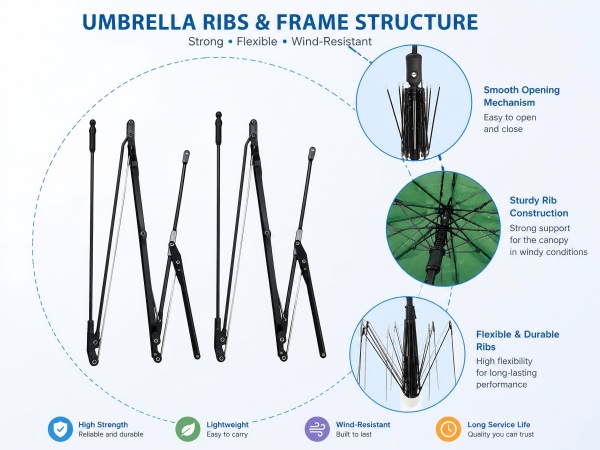
Umbrella ribs are the structural components that extend outward from the umbrella shaft and support the canopy.
When an umbrella is opened, the ribs spread out and create the familiar dome-shaped canopy. When the umbrella is closed, the ribs collapse toward the central shaft.
In simple terms:
The canopy provides coverage, while the ribs provide structural support.
Umbrella ribs are part of the larger umbrella frame, which typically includes several interconnected components such as:
Central shaft
Ribs
Stretchers
Runner
Joints
Connectors
Springs or automatic mechanisms
Tips or rib ends
These components work together to allow the umbrella to open, remain extended, and close properly.
The exact structure varies considerably depending on whether the product is a straight umbrella, folding umbrella, golf umbrella, reverse umbrella, automatic umbrella, or another specialized design.
The term umbrella frame refers to the complete structural system that supports and operates the umbrella canopy.
The ribs are therefore one part of the umbrella frame rather than the entire frame itself.
A typical umbrella frame includes several major components.
The umbrella shaft is the central structural component connecting the handle to the upper frame.
Straight umbrellas generally use a single long shaft, while folding umbrellas use telescopic shafts with multiple sections.
The shaft may be manufactured from materials such as steel, aluminum, or other metal alloys depending on the umbrella design.
The ribs extend from the central structure toward the outer edge of the canopy.
Their primary purpose is to support the fabric and maintain the umbrella's shape when opened.
Stretchers connect the ribs to the runner and help push the ribs outward when the umbrella opens.
They are an essential part of the opening and closing mechanism.
The runner moves along the shaft as the umbrella opens and closes.
In a manual umbrella, the user typically pushes the runner upward to open the canopy.
Automatic umbrellas use spring-loaded or mechanical systems to perform part of this operation.
Folding umbrellas contain multiple joints that allow the ribs to collapse into a shorter package.
The number and arrangement of these joints depend on whether the umbrella is a two-fold, three-fold, five-fold, or another compact design.
The umbrella ribs influence several important product characteristics.
The most basic function of the ribs is to support the canopy and maintain its shape.
Without sufficient structural support, the canopy may sag, deform, or perform poorly during use.
When wind pushes against an umbrella canopy, much of that force is transferred to the ribs and frame.
The ability of the frame to flex, resist deformation, and recover depends on the materials and structural design.
The rib material and construction contribute directly to the total weight of the umbrella.
This becomes particularly important for lightweight folding umbrellas and mini pocket umbrellas.
In a folding umbrella, rib construction affects how compactly the umbrella can collapse.
A five-fold mini umbrella, for example, requires a more complex multi-section rib structure than a straight umbrella.
Frame design can influence how smoothly the umbrella opens, how stable it feels, how easy it is to close, and how much effort is required to operate it.
For these reasons, umbrella ribs should not be considered only as hidden structural components. They are an important part of overall umbrella quality and product design.
Umbrella ribs can be manufactured from several materials. Common choices include steel, fiberglass, aluminum, and combinations of different materials.
There is no single material that is best for every umbrella.
The correct material depends on the target product, size, weight, cost, wind-performance requirements, and intended application.
Steel umbrella ribs are widely used because steel offers useful strength at a practical cost.
Steel components are commonly found in:
Standard folding umbrellas
Straight umbrellas
Promotional umbrellas
Business gift umbrellas
Automatic umbrellas
Steel can provide:
Good structural strength
Stable support
Mature manufacturing processes
Competitive cost
Wide availability
However, steel is generally heavier than some alternative materials.
Depending on the steel type and surface treatment, corrosion protection may also need to be considered.
For products where cost and structural stability are priorities, steel remains an important umbrella frame material.
Fiberglass umbrella ribs have become popular in many modern umbrella designs, particularly where flexibility and lower weight are desirable.
Fiberglass can bend under load rather than behaving exactly like a rigid metal component.
This characteristic makes it particularly useful in umbrella frame designs intended to handle changing wind loads.
Fiberglass ribs are commonly found in:
Golf umbrellas
Wind-resistant umbrellas
Lightweight umbrellas
Straight umbrellas
Folding umbrellas
Premium promotional umbrellas
Depending on the design, fiberglass can provide:
Good flexibility
Relatively low weight
Corrosion resistance
Useful recovery after bending
Good performance in flexible frame structures
However, simply stating that an umbrella has fiberglass ribs does not automatically mean it is windproof.
The complete frame design remains important.
Aluminum is another material used in umbrella frames, particularly when reducing weight is a priority.
It may be used in shafts, rib sections, or other structural components depending on the product.
Aluminum can offer:
Low weight
Corrosion resistance
Clean appearance
Suitability for lightweight designs
For compact travel umbrellas, reducing the weight of each structural component can significantly improve portability.
However, material selection must still be balanced against the required strength and overall umbrella construction.
An umbrella frame does not need to be made entirely from one material.
In fact, many umbrellas use a combination of steel, fiberglass, aluminum, and plastic components.
For example, a folding umbrella might use:
Steel in the shaft
Fiberglass in selected rib sections
Metal at high-load joints
Plastic for certain connectors
This allows the umbrella manufacturer to optimize different parts of the frame for different purposes.
One component may need rigidity, another flexibility, and another minimal weight.
Therefore, when evaluating an umbrella, it is more useful to understand the complete frame construction than simply asking whether the umbrella is "steel" or "fiberglass."
Umbrellas can be designed with different numbers of ribs.
Common configurations include:
6-rib umbrellas
8-rib umbrellas
10-rib umbrellas
12-rib umbrellas
and other specialized structures.
The correct number depends on the umbrella's size, design, weight target, intended use, and frame engineering.
Six-rib structures are commonly found in compact and lightweight umbrellas.
Reducing the number of ribs can help reduce overall weight and simplify the structure.
They are often suitable for:
Mini umbrellas
Pocket umbrellas
Sun umbrellas
Lightweight folding umbrellas
Travel umbrellas
Eight ribs are very common across many standard umbrella designs.
They can provide a practical balance between canopy support, weight, cost, and structural complexity.
Eight-rib structures can be found in folding umbrellas, straight umbrellas, automatic umbrellas, and promotional umbrellas.
Some umbrellas use ten, twelve, or more ribs to provide additional canopy support or create a more substantial product feel.
These structures may be used in umbrellas marketed for stronger construction or enhanced wind resistance.
However, more ribs do not automatically mean a better umbrella.
Adding ribs also increases:
Weight
Number of components
Manufacturing complexity
Potential cost
A well-engineered eight-rib umbrella may perform better than a poorly designed twelve-rib umbrella.
The complete frame should always be considered.
This is a common misunderstanding.
Consumers often assume:
More ribs = stronger umbrella.
In reality, wind performance depends on several factors working together.
These include:
Rib material
Rib thickness
Rib geometry
Number of ribs
Joint design
Stretcher construction
Shaft strength
Canopy size
Canopy shape
Connection points
Manufacturing quality
Flexibility can also be important.
A frame that is extremely rigid may resist moderate forces but become permanently bent or damaged when overloaded.
A carefully designed flexible frame may be able to deform under wind pressure and then recover.
This is one reason fiberglass is frequently incorporated into umbrellas designed for challenging weather.
For B2B buyers, a "windproof" claim should therefore be evaluated based on the complete product design and relevant testing rather than rib count alone.
The rib structure of a folding umbrella is more complex than that of many straight umbrellas.
A folding umbrella needs joints that allow the frame to collapse into multiple sections.
For example:
A three-fold umbrella is designed to balance portability with practical everyday coverage.
The rib system must fold compactly while still providing sufficient support when opened.
This design is widely used for commuting, travel, business gifts, and promotional umbrellas.
A five-fold umbrella requires additional folding sections.
This allows the umbrella to become very compact when closed, making it suitable for mini and pocket umbrellas.
However, the additional joints make the frame more mechanically complex.
For this reason, five-fold umbrellas typically prioritize compact portability rather than simply maximizing structural size.
A golf umbrella usually has a much larger canopy than a compact folding umbrella.
The larger surface area means the frame must support a greater canopy area and potentially experience greater wind loads.
Fiberglass components are frequently used in golf umbrella frames because their flexibility can be useful in large-canopy designs.
When sourcing a golf umbrella, buyers should consider:
Rib material
Shaft material
Open diameter
Frame flexibility
Handle construction
Canopy design
Overall weight
For promotional applications, golf umbrellas also provide a large surface area for custom logos and branding.
A reverse umbrella, also known as an inverted umbrella, uses a different frame geometry from a conventional umbrella.
The canopy closes in the reverse direction, allowing the wet surface to fold inward.
This requires the ribs, stretchers, and opening mechanism to work differently from a standard umbrella frame.
Reverse umbrellas may be available as both:
Reverse Straight Umbrellas
and
Reverse Folding Umbrellas
Because of the specialized structure, frame design is particularly important when developing a reverse umbrella for retail or promotional applications.
The best rib material depends on what the umbrella is expected to do.
| Requirement | Frame Consideration |
|---|---|
| Lightweight travel | Lightweight or mixed-material frame |
| Mini pocket umbrella | Compact multi-section frame |
| Everyday commuting | Balanced steel/fiberglass construction |
| Golf umbrella | Flexible, strong frame construction |
| Wind-resistant design | Flexible ribs and reinforced structure |
| Cost-sensitive promotion | Practical standard frame |
| Premium business gift | Refined frame and smooth mechanism |
| Reverse umbrella | Specialized reverse frame |
Rather than asking which material is universally "best," buyers should define the desired performance first.
A lightweight travel umbrella and a large golf umbrella have very different structural requirements.
For wholesale, promotional, and private-label projects, buyers should evaluate more than the canopy design.
Important questions include:
How many ribs does the umbrella have?
What materials are used in the ribs?
What material is used for the shaft?
Does the frame combine steel and fiberglass?
What is the open diameter?
What is the total umbrella weight?
Is the umbrella manual or automatic?
What type of folding structure is used?
Is wind-resistance testing available?
What quality-control procedures are used for the opening mechanism and frame?
These questions are especially important when comparing quotations from different umbrella suppliers.
Two umbrellas that look almost identical in photographs may use significantly different internal frame structures.
For a custom umbrella project, the frame should be selected together with the canopy, handle, opening mechanism, and intended market.
A promotional company ordering thousands of economical logo umbrellas may need a completely different frame from a premium brand developing a high-end automatic umbrella.
Custom umbrella options can include:
Different rib counts
Steel or fiberglass frame components
Manual or automatic mechanisms
Different canopy diameters
Lightweight constructions
Wind-resistant structures
Straight or folding frames
Reverse umbrella frames
Custom handles
Custom canopy fabrics
Logo printing
Private-label packaging
The objective is not simply to choose the strongest possible frame.
The goal is to find the right balance of:
Strength + Flexibility + Weight + Size + Cost + User Experience
Neither material is always better.
Steel umbrella ribs can provide good strength, structural stability, mature manufacturing, and competitive cost.
Fiberglass umbrella ribs can provide flexibility, lower weight in suitable designs, and good corrosion resistance.
Many high-quality umbrellas combine both materials.
For this reason, the better question is:
Which umbrella frame construction is best for the intended application?
For a mini travel umbrella, weight and compactness may be the priorities.
For a golf umbrella, flexibility and large-canopy support may be more important.
For a promotional umbrella, price, reliability, appearance, and branding potential may need to be balanced.
Umbrella ribs may not be the first thing customers notice, but they are one of the most important parts of an umbrella.
They support the canopy, influence the opening and closing action, affect weight and portability, and contribute to how the umbrella responds to wind.
When comparing umbrellas, remember that quality cannot be determined by rib count alone.
A good umbrella depends on the complete interaction between the:
Ribs + Shaft + Stretchers + Joints + Canopy + Opening Mechanism
Steel, fiberglass, aluminum, and mixed-material frames all have appropriate applications.
The best solution depends on whether the umbrella is designed for travel, commuting, sun protection, golf, corporate gifts, promotions, or demanding outdoor use.
We offer different umbrella solutions for folding umbrellas, straight umbrellas, golf umbrellas, reverse umbrellas, sun umbrellas, promotional umbrellas, and custom logo umbrellas.
Depending on your project requirements, different frame structures, rib materials, canopy fabrics, opening mechanisms, handles, colors, logos, and packaging options can be selected.
Whether you are developing a lightweight folding umbrella, fiberglass golf umbrella, custom promotional umbrella, or private-label umbrella collection, selecting the right frame is an important part of product development.
Contact us with your target umbrella type, size, quantity, frame requirements, logo, packaging, and destination market to discuss a custom umbrella solution for your project.
Contact: Cassie
Phone: 86-17814603169
E-mail: sales@scjumbrellas.com
Whatsapp:86-17814603169
Add: Umbrella Industrial Park Dancheng County, Zhoukou City Henan Province 477150 China